Revelation 21 is not simply the end of the Bible; it is the aim of the entire Bible. It is the horizon toward which all of Scripture, all of history, and all of creation has been moving from the moment the universe came into existence.
Every story in Genesis, every promise to the patriarchs and every psalm and every prophecy points to this moment. Every step of Jesus in Galilee, every miracle and parable, and every drop of His blood point here. Every word from the apostles leads us to the moment when God dwells with His people and makes all things new.
And it is not only Scripture. Every human birth, and every human death. Every wound and every healing. Every exile and every homecoming. Every war and every peace treaty. Every victory we celebrate and every loss we mourn. Every scientific discovery that uncovers the order of God in the cosmos. Every field of knowledge that reveals the artistry of His wisdom. Every civilization that rises and falls. Every heartbeat in every human chest. All of it is moving toward the day when the One who is the Alpha and the Omega will declare, “It is done.”
Revelation 21 is not just the future, but the destiny of everything God has ever made. It is the world the Child of Bethlehem was born to bring into being. We are not simply celebrating a sweet story about a baby in a manger. We are celebrating the arrival of the King who will finish everything He started, and the first dawn of the new creation whose noon-day brightness we see in Revelation 21.
Revelation 21:1 NASB Then I saw a new heaven and a new earth; for the first heaven and the first earth passed away, and there is no longer any sea.
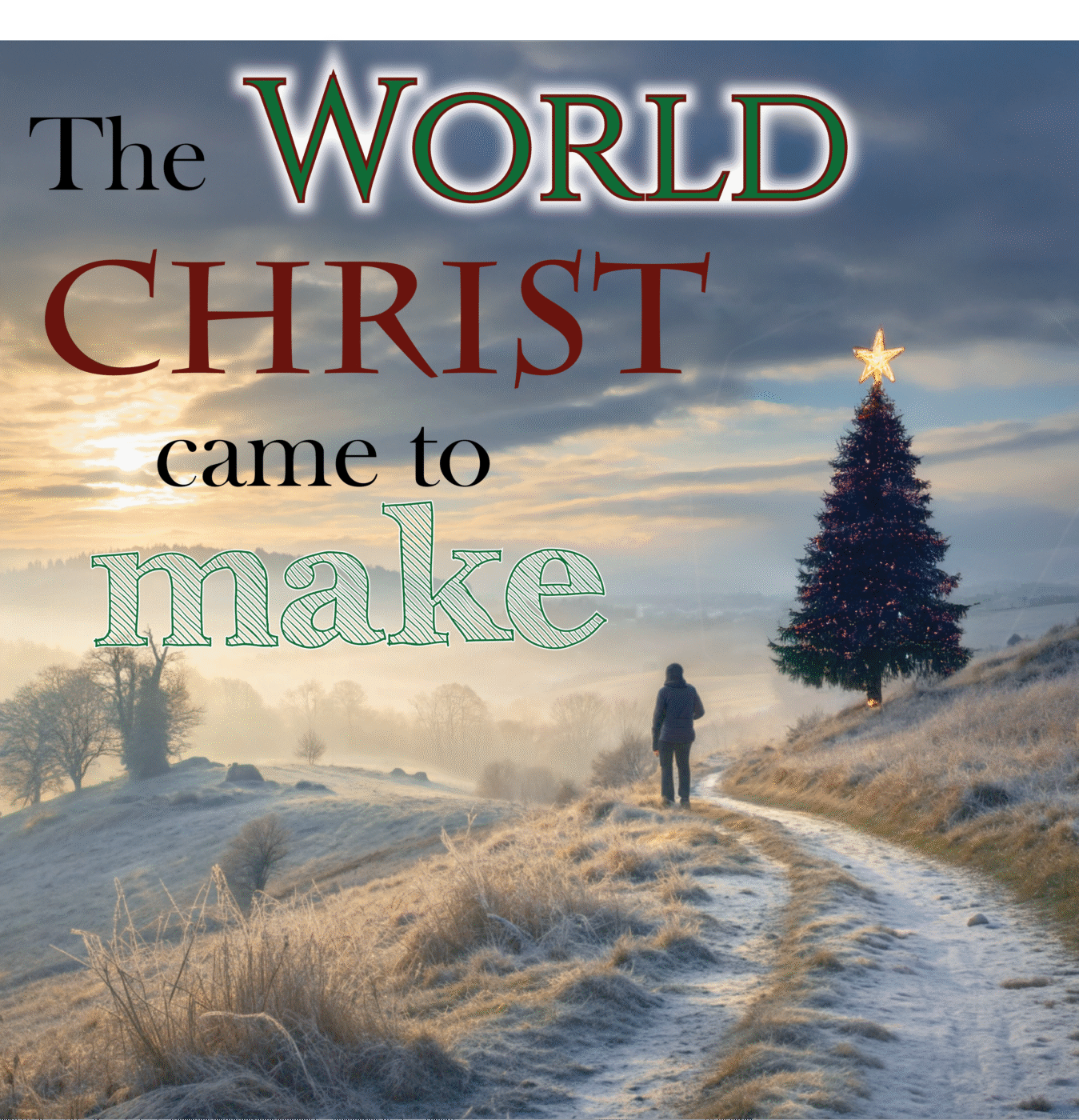
God created earthly realities to reflect heavenly ones. Everything good and beautiful on Earth reflects something more glorious in Heaven. And one day, when Christ returns, the two will be united. Heaven will come to Earth. The new heavens and new earth are not ‘Plan B’; they are the completion of God’s original design. The World Christ Came to Make…
It is a world that replaces the broken one (vs. 1-2)
John says that “the first heaven and the first earth [will pass] away.” This passing will be the reversal of all the corruption in the created order. When Adam sinned, the world came under a curse, and everything that once operated in harmony with God now groans for renewal. Our present world has much beauty to commend, but it is also full of suffering. And its brokenness is not merely environmental or social, but moral and spiritual. There is a pattern of disorder that cannot be fixed by any amount of human effort. Christ does not return merely to mend this broken world. Nothing short of re-creation can heal what sin has destroyed.
Every human attempt to build a utopia has collapsed under the weight of human nature. Nations rise with dreams of peace, justice, and prosperity. Yet every one of them eventually reveals the same corruption that marks the human heart. History is filled with movements that promise renewal yet produce disappointment, oppression, or chaos. People imagine that better systems, better education, or better technology will usher in a perfect society. No matter how boldly people attempt to redesign society or reimagine the self, these projects always fall short because they cannot deal with human sin.
Band-aids will never heal a heart dying from the very corruption it tries to ignore. Re-creation is necessary because no political system can remove guilt. No social movement can cleanse the heart. No scientific advance can reconcile humanity to God. Even the best expressions of human culture bear the marks of pride, idolatry, and self-exaltation. The gospel is not one option among many; it is the only hope for a world that cannot save itself. Therefore,
Don’t expect ultimate satisfaction in this present world.
We search for a deep, settled peace in the wrong places, because we mistakenly treat this current life as our destination rather than the journey. Even if you possessed the very best this world has to offer, with all the money, honor, health, and even the most vibrant church services, it could never satisfy the deepest hunger of your soul. The very best this world has to offer cannot deliver the eternal glory and perfect satisfaction you have committed your life to.
In his book, “The Saints Everlasting Rest,” Richard Baxter, writes: “We are like little children strayed from home, and God is now bringing us home, and we are ready to turn into any house, stay and play with every thing in our way, and sit down on every green bank, and much [effort is required] to get us home.” We risk idolizing temporary comforts, whether worldly pleasures or even spiritual means, and this hinders our necessary, final progress toward Christ.
The challenge is that we often swing between two extremes: expecting too much from this world or caring too little about it. We forget that while this age cannot give ultimate satisfaction, Christ still calls us to love our neighbors and bear witness to His kingdom in it. Anchoring our hope in the new creation while practicing Christlike love in the present one, allows our hearts to serve without idolizing earthly outcomes. And this hope is not vague or abstract. John shows us exactly what God is preparing for His people.
Revelation 21:2 NASB And I saw the holy city, new Jerusalem, coming down out of heaven from God, made ready as a bride adorned for her husband.
This is not humanity climbing upward to reach God but God bringing His world to us. The city is holy because it bears His character. It descends because salvation is His work from first to last. And it is prepared as a bride adorned for her husband, which means the world to come is not merely a rebuilt world but a new world made beautiful. The image is personal, relational, and filled with joy. God is not only restoring creation; He is preparing a place where His people will be welcomed with the delight that a bridegroom has for his bride. Such a future is meant to shape the way we live in the present, because a bride prepares for the day she will see her bridegroom. Thus…
Pursue holiness as those preparing to meet our Bridegroom.
A bride prepares for her wedding day not out of fear, but out of love. In the same way, we grow in holiness by deepening our affection for Christ. The more clearly we see His beauty, the more freely we turn from sin. Holiness is not the misery of self-improvement; it is the joy of loving the One who loved us first.
1 John 3:2-3 NASB Beloved, now we are children of God, and it has not appeared as yet what we will be. We know that when He appears, we will be like Him, because we will see Him just as He is. 3 And everyone who has this hope fixed on Him purifies himself, just as He is pure.
We prepare to meet Christ because our hope is not wishful thinking but a promised future. John shows us where this path of holiness leads: to a world where God dwells with His people, heals every sorrow, and makes all things new.
Revelation 21:3 NASB And I heard a loud voice from the throne, saying, "Behold, the tabernacle of God is among men, and He will dwell among them, and they shall be His people, and God Himself will be among them,
This is the future Christ prepares for His bride: not distance, but nearness; not sorrow, but healing; not decay, but renewal. The God who sanctifies His people now will one day dwell with them in unbroken joy. The World Christ Came to Make…
It is a world filled with the life and love of God Himself (vs. 3-5)
The greatness of heaven is not found in its beauty or its peace or even its freedom from pain. Everything in this passage flows from the reality that greatness of heaven is God’s presence among His people. The new creation is a world saturated with His presence, shaped by His character, and filled with His love.
“Behold, the tabernacle of God is with men, and he will dwell with them.” This is not only covenant language, but also relational language. All through Scripture, God has been drawing near to His people. He walked with Adam in the garden, dwelled with Israel in the tabernacle and filled Solomon’s temple with His glory. He came in human flesh in the person of Christ, dwelling among us and now lives within His people by His Spirit. But here, at the end of all things, God comes to dwell in a way that exceeds every previous experience. No more shadows or symbols, no more mediation, no more distance. God will be with His people in immediate communion, and His presence will be their everlasting joy.
God Himself is the greatest gift of heaven.
Where God dwells in the fullness of His unveiled presence, love fills everything. Jonathan Edwards writes, “the glorious presence of God in heaven, fills heaven with love, as the sun, placed in the midst of the visible heavens in a clear day, fills the world with light.” Heaven is the palace of the God whose very nature is love, and when He dwells with His people in the world to come, they will live in the radiant atmosphere of His kindness, His mercy, and His delight.
And this is why Revelation can say, “they shall be His people, and God Himself will be among them.” The relationship for which we were created and redeemed reaches its intended end. God’s people will belong to Him without fear and without interruption. Those who have died in Christ have not drifted into some vague existence. They are already experiencing the comfort of belonging to God in a way that will one day be shared by all His people in fullness. Which is why the apostle Paul said that he preferred “to be absent from the body and to be at home with the Lord.” In the presence of Christ, the believer will no longer be overwhelmed by despair and sorrow because…
Revelation 21:4 NASB He will wipe away every tear from their eyes; and there will no longer be any death; there will no longer be any mourning, or crying, or pain; the first things have passed away."
It is hard to imagine, but there will be no morning in heaven, which leads many to wonder if we will have our past memories fully intact. Our present world is full of tears, death, mourning, and pain that greatly shapes who we are. Will the saints be themselves in heaven? Matthew 17:3 says that during His transfiguration, Jesus disciples were able to distinguish Moses from Elijah, who had been deceased for multiple centuries. Luke 16:23 says that the damned souls in Hell recognized Abraham and Lazarus. Abram even calls upon the dead to “remember that during your life you received your good things, and likewise Lazarus bad things; but now he is being comforted here, and you are in agony.”
You will be you in heaven. Your personal identity and history are an important part of what makes you, you. But all the past regrets and disappointments will be displaced by heaven’s joy. You will remember your past sins but no longer feel guilt or shame because Christ removes all condemnation the moment someone places their faith in Him. How else would we be able to magnify His mercy and grace through eternity?
How does Christ remove condemnation? Not by overlooking our sin or pretending it never happened, but by bearing it Himself. At the cross, every sin that would have brought us mourning, crying, and pain fell upon the sinless Son of God. Isaiah saw it seven centuries before it happened: ‘He was pierced through for our transgressions, He was crushed for our iniquities; the chastening for our well-being fell upon Him, and by His scourging we are healed.’ The tears God will wipe away in the new creation are tears that would have flowed forever in the lake of fire, except that Christ wept them, bled them, died them in our place.
What about the grief we feel over loved ones who reject Christ? Scripture does not say that our memories will be erased. It does say that all sorrow will be taken away. The reason is not that we will become less compassionate, but that we will see God more clearly than ever before. In this life, our understanding of His righteousness is partial, and our hearts are clouded by the ache of sin and loss. But in the world to come, the glory of His holiness will swallow up every doubt and every protest in perfect clarity. The redeemed will fully behold the beauty of God’s justice, the purity of His judgments, and the infinite goodness of all His ways. Heaven’s joy does not rest on forgetting what is painful, but on seeing God as He truly is.
And if the full revelation of God’s righteousness and love will quiet every sorrow in the world to come, then His promises are enough to steady trembling hearts in the world we inhabit right now.
Present suffering can be endured with confident hope.
For the believer, hope is not wishful thinking. It is confidence rooted in the character of God. The same hand that will one day wipe away every tear is the hand that upholds His people in their darkest nights. Pain has a way of shrinking our horizon. Instead of seeing God’s promises, we often see only what hurts right now. The fog of grief can make God’s goodness feel distant and His timing slow. Hope is not the absence of pain. It is the refusal to let pain interpret God for us.
When sorrow shrinks our horizon, we turn again to the God whose character does not change when our circumstances do. We lean on the prayers and encouragement of Christ’s people when our own strength fails. We cling to the Scriptures that anchor us when everything else feels unstable. And we trust that the God who promises to wipe away every tear then is the God who walks beside His people now. Confident hope grows not by denying our suffering, but by holding fast to the God who has promised that suffering will not have the last word.
Felicitas of Rome was a Christian widow in the second century whose seven sons were martyred one by one before her eyes for refusing to sacrifice to Roman gods. According to early accounts, she encouraged each son: “My child, look up to heaven where Christ awaits you. That is your true life.” She did not minimize the horror. She embodied the hope that suffering, even the kind that tears a mother’s heart, is not the final word because…
Revelation 21:5 NASB And He who sits on the throne said, "Behold, I am making all things new." And He said, "Write, for these words are faithful and true."
“He who sits on the throne” is the sovereign King over all creation, and His first word is a word of promise: “Behold, I am making all things new.” Not “I will try,” or “I may,” but “I am making.” It is the language of certainty from the One whose purposes cannot be frustrated. God is not merely repairing what sin has damaged; He is recreating and renewing all things by His own authority. The brokenness we feel so deeply now, the decay that marks this world, the griefs that press on every heart, all stand under this promise. God is at work even when we cannot see His hand.
And then He gives a command to John: “Write, for these words are faithful and true.” God is telling every believer that this future is not imaginary. It is guaranteed by the One who sits on the throne. The God who rules all things is the God who renews all things, and He calls us to trust that His promises are as sure as His throne.
Our faith rests on the certainty of God’s promises.
The same sovereign voice that promises to make all things new continues speaking, moving from promise to completion and from completion to invitation. These words reveal the heart of the God who renews all things.
Revelation 21:6-8 NASB Then He said to me, "It is done. I am the Alpha and the Omega, the beginning and the end. I will give to the one who thirsts from the spring of the water of life without cost. 7 "He who overcomes will inherit these things, and I will be his God and he will be My son. 8 "But for the cowardly and unbelieving and abominable and murderers and immoral persons and sorcerers and idolaters and all liars, their part will be in the lake that burns with fire and brimstone, which is the second death."
In these verses, God speaks with tenderness and with truth, offering life to the thirsty while warning the unrepentant of the judgment to come. Heaven’s future is opened by invitation and guarded by holiness.
It is a world that invites the thirsty and excludes the unrepentant (vs. 6-8)
God declares, “It is done,” signaling the completion of His redemptive plan. As the Alpha and the Omega, He stands at both the beginning and the end of history, guaranteeing the certainty of His promise. He extends an open invitation: the water of life is offered freely to all who thirst, all who come to Him in humble dependence. Yet this invitation stands beside a sober warning. Those who persist in unbelief and rebellion will face the second death. The new creation is a world of grace and holiness, where God welcomes the thirsty and excludes all who refuse His mercy.
Grace is free, but it must be received.
God offers the water of life “without cost.” Although the water of life is free, it was infinitely costly to Christ. On the cross the Son of God bore the judgment that all of our cowardly unbelief, our idolatry, our lies deserved. The second death that awaits the unrepentant fell upon Christ in the Christian’s place. He drank the cup of God’s wrath to the dregs so that He could offer us the cup of living water. The invitation is free because the payment has been made.
Yet the only ones who receive it are “the thirsty.” This is the posture of a soul aware of its need. Grace is never earned, achieved, or negotiated. It is given to those who come to Christ with empty hands. The most tragic mistake a person can make is to assume that God’s generosity removes the necessity of repentance. The water of life is free, but it is not forced upon the unwilling. Heaven is a world where every inhabitant has come to Christ in humble dependence, admitting their need and receiving His mercy.
Our perseverance in faith has eternal consequence.
“He who overcomes will inherit these things.” Perseverance does not earn salvation, but it does demonstrate the reality of saving faith. The promises of God belong to those who continue to trust Him to the end. For weary believers, this is not meant to produce fear but encouragement. The God who saves is the God who keeps. He strengthens His people so that they endure trials, resist sin, and cling to Christ. The eternal inheritance belongs to those who rest in Him, not in themselves.
The world Christ came to make is holy, not morally neutral.
Verse 8 gives us a sobering catalogue: the cowardly and unbelieving and abominable and murderers and immoral persons and sorcerers and idolaters and all liars. We’re trained to see lists like this as judgmental or exclusionary. But notice that God is not arbitrarily selecting behaviors He dislikes. He’s describing patterns of life that are fundamentally incompatible with His presence.
If you invite someone into your home who insists on bringing a bonfire with them, the problem isn’t your in hospitality, it’s that fire destroys homes. The new creation cannot be infiltrated by what destroys, corrupts, and defiles. Heaven is not a morally neutral space where “anything goes.” It is the realm where God’s holiness dwells in fullness, and holiness by its very nature cannot coexist with that which tears life apart.
This list is not merely behavioral. Notice that “the cowardly and unbelieving” appear first, before the more obvious moral failures. Why? Because what ultimately excludes someone from God’s presence is not the magnitude of their sin but their refusal to bring it to Christ. The cowardly are those who knew the truth but lacked the courage to stake their lives on it. The unbelieving are those who heard the gospel but would not trust it. What bars entrance to the new creation is not that we have sinned, but that we will not admit our need and receive His mercy.
In fact, if you look at the sins listed here, idolatry, immorality, deception, they are not random vices. They are the very things that destroy human flourishing in this world. God is not being arbitrary. He’s saying, “The world I am making is one where these life-crushing patterns will never exist again.” This is not cruelty; it is mercy. God loves His people too much to allow into the new creation the very things that have caused so much suffering in this one.
And notice the surprising gentleness with which this warning is given. It comes immediately after the invitation to the thirsty. God is not gleefully excluding people. He is earnestly warning them that if they persist in refusing His grace, they will face what C.S. Lewis called “the supreme horror”, getting exactly what they’ve always wanted: a world without God. Hell is not God’s vindictive punishment on those who didn’t measure up. It is the tragic destination of those who, to the very end, said “I will not have this man rule over me.”
This is both sobering and merciful. It calls sinners to repentance before it’s too late. And it assures believers that evil, real, corrupting, life-destroying evil, will never again invade God’s world. Christ came not to create a vague spiritual realm of tolerance, but a holy kingdom where righteousness dwells and where His people live in the purity and peace for which they were made.
Conclusion
We celebrate Christ’s first coming because it guarantees His second. The child laid in a manger is the King who will return to make all things new. Heaven and nature will sing when He appears in glory. Sins and sorrows will no longer grow. Thorns will no longer infest the ground. Every trace of the curse will give way to the world He promised, a world filled with His life and love. He will fill the world with truth and grace and make the nations prove the glories of His righteousness.
For those who grieve, this is not a distant dream. The Savior who came in humility will come again in power, and He will wipe away every tear His people have ever shed. The One who offered the water of life freely will satisfy every longing heart. The God who now calls us to persevere will hold us fast until the day we see Him face to face.
So, as we wait, we wait with hope. We serve with joy. We endure with confidence. The story of this world is moving toward the day when Christ dwells with His people and everything broken is made whole. Advent reminds us that God keeps His promises, and that the world Christ came to make is not imaginary but certain. Therefore, let every longing heart lift its eyes. The King who came will come again, and in His presence all things will be made new.